Germany's 10-Day Emergency Supplies: What the BBK Recommends
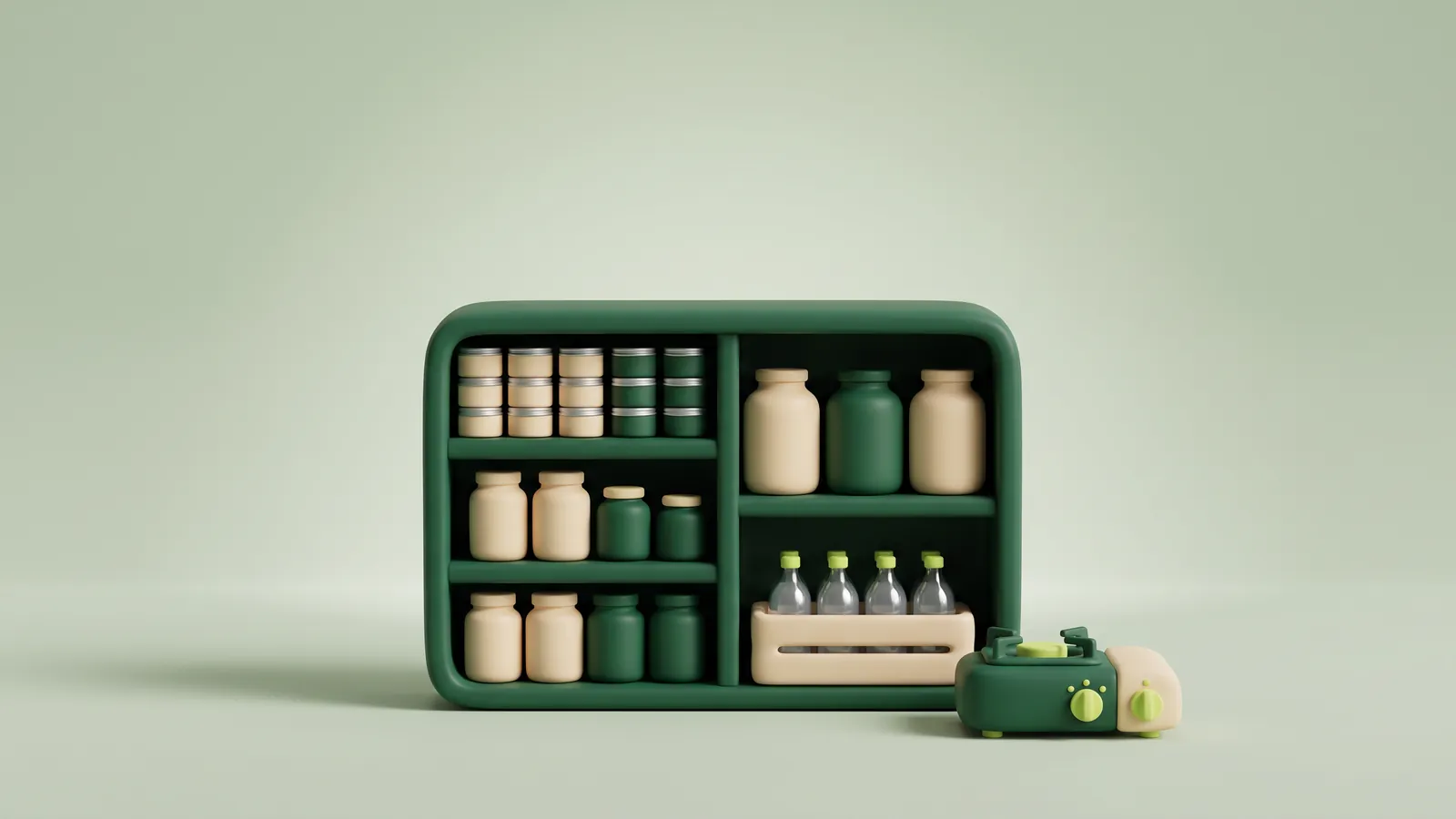
Quick answer: Germany’s Federal Office of Civil Protection and Disaster Assistance (BBK) recommends that households keep food and drink for ideally 10 days, and at least 3 days. Plan on 2 litres of water per person per day (1.5 litres to drink plus 0.5 litres for cooking), which is 20 litres per person for 10 days (about 5.3 US gallons). In October 2025 the BBK published a fully revised guide, Vorsorgen für Krisen und Katastrophen (Preparing for Crises and Disasters).
Germany asks for more than the EU’s 72-hour minimum. That can sound like a lot, but most of it is everyday food you already eat. Here is what the BBK says, the numbers behind it, and how to build up to it without stress.
What changed in October 2025
On 13 October 2025, the International Day for Disaster Risk Reduction, BBK President Ralph Tiesler presented the newly revised guide. It replaces the older brochure many Germans knew as the Ratgeber für Notfallvorsorge und richtiges Handeln in Notsituationen (Guide to Emergency Preparedness and Correct Action in Emergencies).
The new version keeps the classic advice on power cuts, floods and extreme weather, and on stocking sensible supplies. It adds:
- how to spot disinformation
- where to take cover if there is an explosion
- psychological tips for coping with fear in extreme situations
- how to receive and act on official warnings
The BBK said its own surveys found that 53% of people had taken no specific steps to prepare.
The guide is free as a printed booklet and online. Its contents are also in the NINA warning app. The BBK lists versions in Easy German (Leichte Sprache) and German Sign Language, plus Arabic, English, French, Polish, Russian, Spanish, Turkish and Ukrainian. The Easy German version was updated on 2 June 2026.
Why 10 days, and why at least 3
The BBK’s wording is to stock supplies for “ideally ten days”, while noting that even three days helps a lot. The reasoning is practical. A long power cut, a flood or a broken supply chain can leave shops shut or empty for days. The longer you can manage at home, the less pressure there is on emergency services.
Water comes first. The BBK points out that people can survive about three weeks without food but only around four days without fluids.
How much water per person
The BBK’s figure is 2 litres per person per day:
- 1.5 litres to drink (an adult’s minimum)
- 0.5 litres for cooking pasta, rice and potatoes
The government’s food-stockpile calculator adds two refinements. People aged 65 and over are advised to drink about 2 litres a day, so plan a little extra for them. Children up to 12 (not babies) drink about 1 litre a day on average.
| Household | 3 days | 10 days |
|---|---|---|
| 1 adult | 6 litres | 20 litres (about 5.3 US gal) |
| 2 adults | 12 litres | 40 litres (about 10.6 US gal) |
| 4 people | 24 litres | 80 litres (about 21 US gal) |
These figures cover drinking and cooking. They do not include washing or flushing the toilet, so the BBK checklist also suggests keeping containers of water for those uses. For storage tips, see how much water to store.
How much food per person for 10 days
The BBK refers households to the federal food-preparedness website, ernaehrungsvorsorge.de, run by the federal agriculture and food ministry (BMLEH) and the Federal Office for Agriculture and Food (BLE). Its calculator is based on 2,200 kcal per person per day. For one person for 10 days it suggests:
| Food group | Amount for 10 days | Examples |
|---|---|---|
| Drinks (mainly water) | 20 litres | Bottled water, juice |
| Cereals, bread, potatoes | 3.3 kg (about 7.3 lb) | Pasta, rice, oats, crispbread |
| Vegetables and mushrooms | 4.0 kg (about 8.8 lb) | Tinned or jarred vegetables, pulses |
| Fruit | 2.5 kg (about 5.5 lb) | Tinned fruit, dried fruit |
| Milk and dairy | 2.5 kg (about 5.5 lb) | UHT milk, hard cheese |
| Eggs, meat, sausage, fish | 1.2 kg (about 2.6 lb) | Tinned tuna, tinned meat |
| Fats and oils | 0.33 kg (about 0.7 lb) | Cooking oil, butter |
These are general amounts. Adjust them for allergies, diets, small children and pets, as the BBK advises.
Choose food you can eat cold, because a power cut may stop you cooking. The rest should cook quickly on a camping stove or gas grill. The BBK checklist includes both an alternative way to cook and the fuel for it.
What else the BBK checklist includes
The revised checklist (Checklisten zur Vorsorge) goes beyond food. The main groups are:
- Information: solar, battery or wind-up radio; a warning app such as NINA; charged power bank; phone numbers on paper
- Light and warmth: torch and spare batteries, candles and lighter, warm clothes, blankets, sleeping bags, and a heater that works without mains power, with fuel
- Medicine cabinet: your personal medicines, painkillers, fever reducers, thermometer, dressings, disinfectant, and remedies for diarrhoea, colds and sunburn
- Hygiene: soap, toothpaste, toilet paper, wet wipes, period products or nappies, and strong bin bags that can line the toilet
- Fire safety: smoke alarm, fire extinguisher or spray, carbon monoxide alarm
- Grab bag (Notgepäck): documents folder, first aid kit, medicines, power bank, water bottle, food, torch, radio, cash and spare glasses or hearing aids
- Other: extra cash, FFP2 masks, water containers, and a camping toilet
For medicines, our guide to medications in emergencies explains how to build a safe reserve with your doctor or pharmacist.
What this means for you, wherever you live
Germany’s figures are a useful benchmark for anyone, because they are specific. Even if your country only asks for 72 hours, the BBK numbers tell you what “enough” looks like for a person per day.
- Start with 3 days, then grow. The BBK checklist itself is split into 3, 5, 7 and 10 days. Tick off one level at a time.
- Use a “living” stockpile. The BBK describes two methods: buy once and check dates yearly, or keep a rolling stock that you use and replace as part of normal shopping. The second wastes less. Our food rotation guide shows how.
- Spread the cost. Ten days for a family sounds expensive, but adding a few items each shop makes it manageable. See stockpiling on a budget.
Want a number for your own home? See how many days your household would last with the free calculator.
Your 10-day checklist
- Water: 2 litres per person per day (20 litres per person for 10 days)
- Extra water for washing and flushing
- Food for 10 days, using the table above as a guide
- A camping stove or gas grill and fuel, for outdoor use
- Personal medicines and a stocked medicine cabinet
- Radio, torch, spare batteries and a charged power bank
- NINA or your local warning app installed
- Warm bedding and clothes
- Hygiene supplies, including bin bags for an emergency toilet
- A packed grab bag with documents and cash
- Smoke and carbon monoxide alarms tested
Build it step by step and you will be ready for most disruptions long before you reach day ten. In Germany, follow the BBK and your local authorities; elsewhere, follow your own national advice.
Sources & further reading
- BBK – Essen und Trinken bevorraten (stocking food and drink)
- BBK – Ratgeber: Vorsorgen für Krisen und Katastrophen (guide and downloads)
- BBK press release – New BBK guide gives orientation in uncertain times, 13 October 2025
- BBK – Checklists for emergency preparedness (PDF)
- BBK – Food: personal preparedness of the population
- Ernährungsvorsorge.de – Food stockpile calculator (Vorratskalkulator)
- City of Heidelberg – Crisis guide newly published, 3 November 2025
Every fact in this post was checked against the sources listed above on 1 November 2026. Advice changes: always follow your local authorities.
Put it into numbers
See how many days your household would last today, and what it costs to reach your goal.