Switzerland's Emergency Stockpile (Notvorrat): The Official List
Quick answer: Switzerland’s Federal Office for National Economic Supply (FONES, in German BWL) advises every household to keep an emergency stockpile, or Notvorrat, of food for about one week. For water it recommends at least 9 litres per person, one six-pack of 1.5-litre bottles, which covers drinking and cooking for three days at about 3 litres a day. The list also includes a radio, torch, gas cooker, 50 hygiene masks per person, medicines, cash and pet food. The trick is to eat from it and replace it as part of normal life.
Alongside the country’s own supply planning, the Swiss government asks every household to keep a small reserve at home. Here is the current official advice in plain English.
Why Switzerland asks households to keep a Notvorrat
FONES explains that a stockpile helps bridge temporary supply shortages, not long crises. Roads can be blocked and transport can fail, which could cut off food deliveries to smaller communities for several days. A household that can feed itself for a while takes pressure off the system while services are restored.
FONES links this to recent experience. When it relaunched its campaign in October 2024, it pointed to the Covid-19 pandemic and the extreme weather that hit parts of Switzerland in 2024 as reminders that unexpected situations can arise at any time.
The official shopping list
This is the FONES recommendation, from its “Kluger Rat – Notvorrat” brochure and website.
Drinks
| Item | Amount |
|---|---|
| Water | At least 9 litres per person (one six-pack of 1.5 L bottles) |
| Other drinks | As you like |
Nine litres is enough to drink and cook with for about three days. That means water is the first thing to run out if you plan for a full week, so many households store more. Our guide to how much water to store explains how to scale it up.
Food for about one week
FONES suggests long-lasting food your household already eats, for example:
- Rice, pasta and oil
- Ready meals and tinned food
- Salt, sugar, coffee and tea
- Dried fruit, muesli and rusks
- Chocolate
- UHT milk and hard cheese
- Dried meat
It also suggests including some food that can be eaten without cooking, in case there is no power.
Other essentials
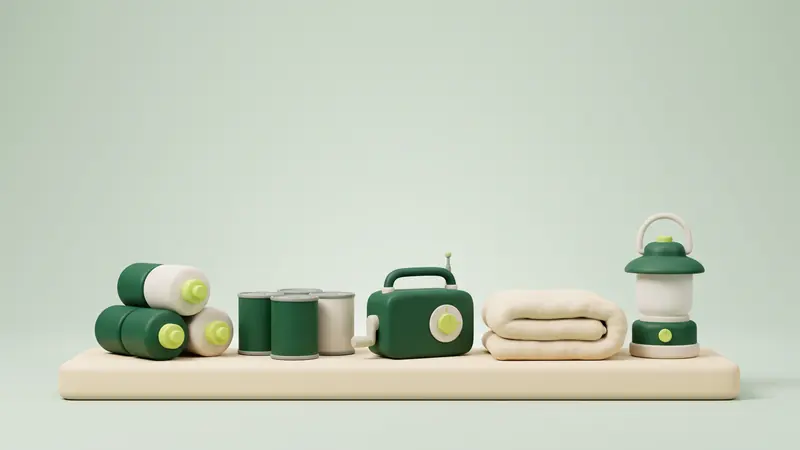
- Battery-powered radio
- Torch
- Spare batteries
- Candles, and matches or a lighter
- Gas cooker
- 50 hygiene masks per person
- Disinfectant
- Personal medicines
- Everyday toiletries
- Some cash
- Pet food
How to store it: build it into your kitchen
The core Swiss advice is not to create a separate emergency cupboard you never open. Instead, FONES asks people to fold the stockpile into their normal kitchen routine: use the food regularly and replace it.
- Store food in a cool, dry, dark place.
- Keep an eye on best-before dates.
- Food in your freezer counts towards the stockpile.
This is the same “eat and replace” idea Japan calls rolling stock. Our guide to food rotation (first in, first out) shows how to set it up, and our post on Japan’s rolling stock method explains how Tokyo does it.
The calculator: a list for your household
FONES runs a free online emergency stockpile calculator (Notvorratsrechner). You enter:
- How many adults, young people aged 12 and over, children aged 2 to 12 and infants under 2 live with you
- Whether you have pets
- How many days you want to cover (the default is 7 days)
- Dietary preferences for each person
It then produces a personal shopping list. In January 2025, Swiss news site blue News tried it for a family of four with two children under 16. The calculator suggested about 70 litres of mineral water plus basics such as pasta, rice and tinned vegetables for seven days, and 200 masks.
That example shows how the 9-litre minimum and a full week differ: covering seven days needs much more water than three.
The 2024–2026 awareness campaign
FONES has been running a steady campaign since 2024:
- 8 October 2024: a new nationwide campaign launched with Swiss retailers and the cantons, including the online calculator, an explainer video and tips for young parents and pet owners.
- 17 February 2025: an updated “Kluger Rat – Notvorrat” brochure came out in German, French and Italian. It repeats the advice to keep a stockpile for about a week.
- October 2025: the brochure became available in English, and sign-language versions of the videos were added.
- 21 April 2026: an easy-language version of the brochure and website launched with a specialist easy-language centre. FONES says around 1.25 million adults in Switzerland benefit from easy-to-read information.
FONES has also said it plans a study on how to reach different groups more effectively with stockpile advice.
How Switzerland compares
Switzerland sits at the longer end of European advice. The EU and many member states use a 72-hour target. Sweden, Norway and Estonia ask for a week, and Germany suggests up to 10 days. See our country comparison and our post on Germany’s 10-day advice.
What this means for you, wherever you live
The Swiss list is a sensible template for almost any household.
- Aim for a week of food. Use what you already eat so nothing is wasted. Our 30-day food stockpile guide helps if you want to go further.
- Treat 9 litres per person as the minimum, not the goal. For a week, plan for more.
- Don’t forget non-food items: light, a radio, a way to cook, medicines and some cash. Our 72-hour emergency kit guide has a full list.
- Build it slowly. Adding a few items each week keeps costs low. See stockpiling on a budget.
Want a quick read on where you stand? See how many days your household would last with our free calculator.
Checklist
- At least 9 litres of water per person, and more if you plan for a week
- About a week of long-lasting food you normally eat
- Some food that needs no cooking
- Battery radio, torch and spare batteries
- Candles and matches or a lighter
- Gas cooker and spare cartridges, used with good ventilation
- Hygiene masks, disinfectant and toiletries
- Personal medicines
- Some cash
- Pet food, if you have pets
- Stored cool, dry and dark, and used and replaced regularly
If you live in Switzerland, follow FONES and your canton’s advice. Elsewhere, check your national emergency agency.
Sources & further reading
- FONES – We advise: emergency supplies (English)
- BWL – Notvorrat (German)
- BWL – Kluger Rat – Notvorrat brochure (German)
- BWL – New brochure, February 2025 (German)
- BWL – Newsletter, November 2025 (German)
- BWL – Notvorrat in easy language, April 2026 (German)
- FONES – Emergency stockpile calculator
- blue News – Swiss should stock up on emergency supplies: campaign launch (Oct 2024)
- blue News – Check your emergency stockpile for the siren test (Jan 2025)
Every fact in this post was checked against the sources listed above on 1 November 2026. Advice changes: always follow your local authorities.
Put it into numbers
See how many days your household would last today, and what it costs to reach your goal.