Hurricane, Typhoon and Cyclone Season: What Supplies You Need
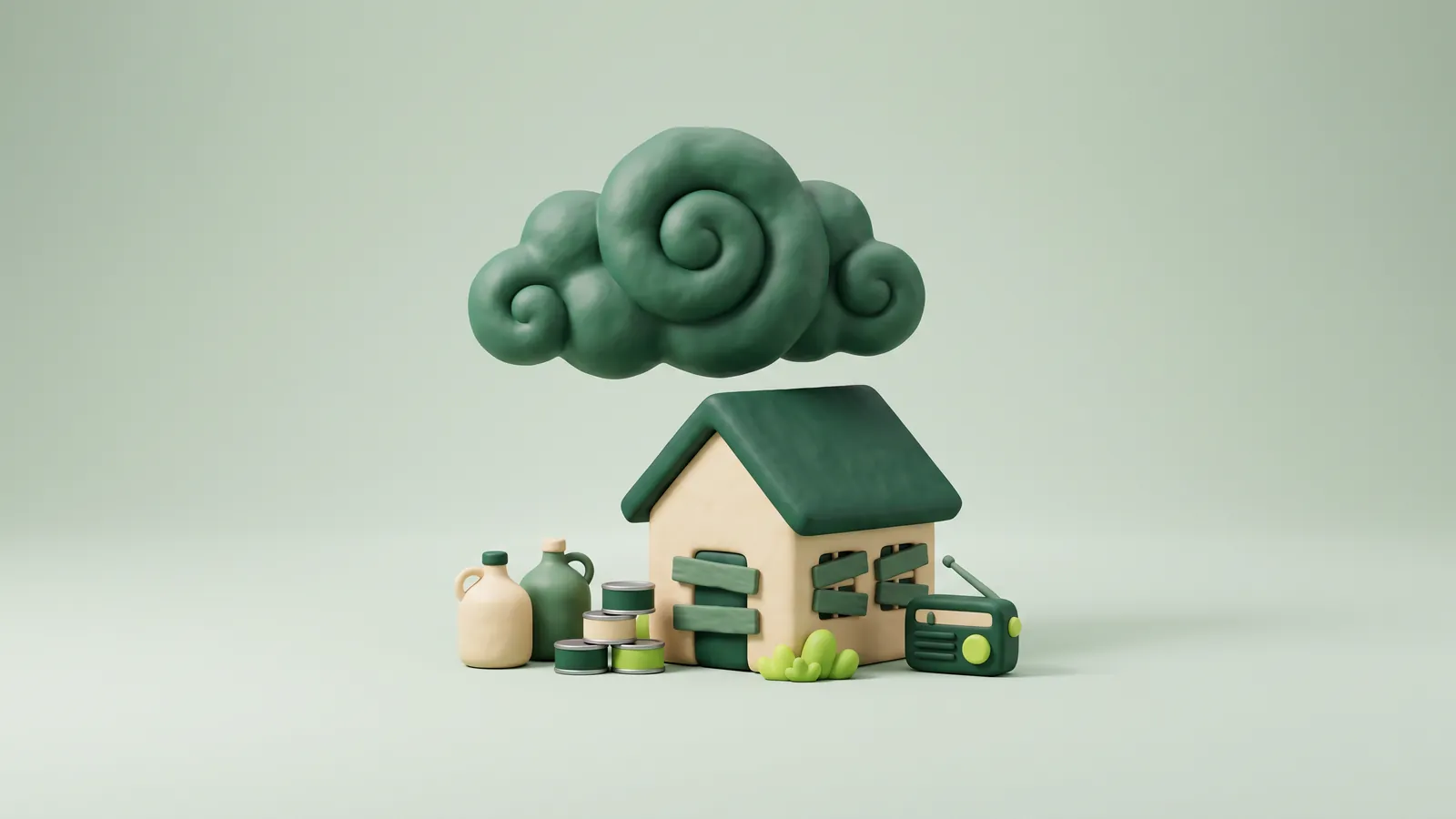
Quick answer: Official advice for tropical storm season ranges from at least 3 days of food, water and medicine (the US National Weather Service and Queensland’s Get Ready campaign) to at least 7 days (Florida’s Division of Emergency Management). Queensland asks for a minimum of 10 litres of drinking water per person for three days. Recent storms show the power can stay off for days, and after the worst storms for months, so treat three days as the floor, not the goal.
Whatever your region calls them, these storms bring the same problems: wind damage, flooding, blocked roads and long power cuts. The calmest time to prepare is before the season starts, so that a forecast becomes a reminder rather than a scramble.
What recent storms tell us about power cuts
The length of an outage depends on how much of the network is damaged. Three recent storms show the range.
- Hurricane Beryl, Texas, July 2024. Beryl came ashore on 8 July 2024. Power cuts peaked at 2.7 million customers. Nearly three days later, 1.6 million customers in the Houston area were still without power, in heat the National Weather Service called potentially dangerous.
- Hurricane Melissa, Jamaica, October 2025. The US National Hurricane Center reported that Melissa’s eye reached western Jamaica on 28 October 2025 with maximum sustained winds estimated at about 295 km/h (185 mph). Four months later, at the end of February 2026, the utility JPS had restored 99% of customers, but 8,653 were still without electricity.
- Super Typhoon Fung-wong, Philippines, November 2025. More than 1 million people were evacuated before Fung-wong made landfall in Aurora province on 9 November 2025. Its band of rain and wind was about 1,800 km wide, and several eastern towns lost power. It arrived days after Typhoon Kalmaegi had killed at least 224 people in the Philippines.
The lesson is simple. Most outages are measured in days, but a direct hit from a very strong storm can mean weeks or longer. Supplies for three days get you through the first, most chaotic stretch, when roads are blocked and shops are shut.
What official agencies tell households to stock
Agencies agree on the core items. They differ mainly on how long to plan for.
| Agency | How long to plan for | Key points |
|---|---|---|
| US National Weather Service | At least 3 days | Food, water and medicine per person; power and water may be off at least that long |
| Florida Division of Emergency Management | At least 7 days | Build a kit for your household; know your evacuation zone and how strong your home is |
| Get Ready Queensland (Australia) | 3 days, more if rural or remote | At least 10 litres of drinking water per person; a week’s supply of important medicines |
Put together, the advice covers:
- Water: at least 10 litres (about 2.6 US gallons) of drinking water per person for three days, per Queensland’s guidance. See how much water to store for longer periods.
- Food: non-perishable food you can eat without cooking.
- Medicines: a week’s supply of important medicines, plus a first aid kit.
- Information: a battery-powered radio, because mobile networks and the internet may fail.
- Light and power: torches or a battery lantern, spare batteries, a charged power bank, and a crank or solar USB charger.
- Cash: the National Weather Service lists extra cash, because card machines need power. Our post on keeping cash at home explains how much.
- Documents: copies of ID and insurance papers in waterproof storage.
Stay or go: sheltering versus evacuating
The decision usually comes down to two questions: are you in an evacuation zone, and how strong is your home? Florida asks residents to know both before a storm is on the way.
If you are told to evacuate, go. Ready.gov advises learning your evacuation routes, practising them with your household and pets, and deciding in advance where you will stay. Follow instructions from your local emergency managers.
If you stay at home, Ready.gov’s advice is:
- Shelter from high winds in a designated storm shelter or an interior room.
- If you are trapped by flooding, go to the highest level of the building.
- Turn off electricity at the main breaker if it is safe to do so.
- Never walk, swim or drive through flood water. About 15 cm (6 inches) of fast-moving water can knock you over, and 30 cm (1 foot) of moving water can sweep a car away.
Tokyo’s official disaster guide, Tokyo Bousai, adds some practical points for typhoons. If you are at home, stay inside until the storm has passed, and do not go out to fix the roof or windows. Use the stairs rather than lifts during typhoons and heavy rain, because a power cut can leave you stuck. If you see water flowing in, move to higher ground straight away rather than waiting for it to rise.
After the storm: running your home without power
The days after a storm can be harder than the storm itself. It may be hot, roads may be blocked, and help may be stretched.
- Generators save lives only when used outdoors. The US Centers for Disease Control and Prevention (CDC) says to place them outside, more than about 6 metres (20 feet) from windows, doors and vents, and never in a home or garage. Fit a battery-powered carbon monoxide alarm near where people sleep.
- Keep in touch by text. Ready.gov suggests texting or using social media rather than phoning after a hurricane. A simple family emergency communications plan helps everyone know who to contact.
- Plan your food and light. Our guide to power outage preparation covers food safety, lighting and keeping phones charged.
- Photograph any damage before you start cleaning up, for insurance.
What this means for you, wherever you live
You do not need to live on a hurricane coast for this advice to matter. The same plan covers any storm that could cut power, water and roads for several days.
- Start with three days, then build towards seven. Florida’s seven-day figure is a sensible target for anyone in a storm-prone area.
- Get ready before the season, not before the storm. Waiting for a forecast means shopping at the same time as everyone else. Add a few items each week during quiet months; stockpiling on a budget shows how.
- Plan for medicines early. Ask your doctor or pharmacist about a reserve. Our guide to medications in emergencies explains how.
- Know your number. See how many days your household would last with the free calculator, then fill the gaps.
Your storm-season checklist
- Drinking water: at least 10 litres per person for three days, more if you can
- Non-perishable food for at least 3 days, aiming for 7
- A week’s supply of important medicines and a first aid kit
- Battery-powered radio, torches and spare batteries
- Charged power bank and a crank or solar charger
- Some cash in small notes
- Copies of ID and insurance papers in a waterproof bag
- Know your evacuation zone, your routes and where you would stay
- Choose the safest interior room in your home
- Battery carbon monoxide alarm fitted if you might use a generator
Most of this is ordinary food, water and kit you can gather over a few weekends. When a storm is forecast, follow the warnings and instructions from your local and national authorities.
Sources & further reading
- US National Hurricane Center – Hurricane Melissa discussion, 28 October 2025
- US National Weather Service – Hurricane preparedness: disaster supplies
- Ready.gov – Hurricanes
- Florida Division of Emergency Management – Plan and prepare
- Get Ready Queensland – Pack an emergency kit
- Tokyo Metropolitan Government – Tokyo Bousai: other disasters and countermeasures (English PDF)
- CDC – Carbon monoxide poisoning basics
- PBS NewsHour (AP) – Houston swelters as power company faces pressure three days after Beryl, July 2024
- Jamaica Observer – JPS restores power to 99% of customer base, March 2026
- PBS NewsHour (AP) – Super Typhoon Fung-wong slams into the Philippines, 9 November 2025
Every fact in this post was checked against the sources listed above on 1 November 2026. Advice changes: always follow your local authorities.
Put it into numbers
See how many days your household would last today, and what it costs to reach your goal.